
If you hesitate before letting an AI score your applicants, you are not being paranoid. You are being well-read. The horror stories are real, the research on bias is peer-reviewed, and the most common reassurance in the industry, "don't worry, a human reviews everything," turns out to be much weaker protection than it sounds.
This post walks through the actual evidence, then makes a specific argument: the difference between AI screening you can trust and AI screening you cannot is not whether a human is in the loop. It is whether the human gets reasons they can check, or just a number they can only accept.
The horror stories, told accurately
Three stories come up in every conversation about AI hiring, and they deserve to be told with their caveats attached, because the details matter.
Amazon's scrapped recruiting engine. In 2018, Reuters reported that Amazon had abandoned an internal, experimental recruiting tool after discovering it penalized resumes containing the word "women's" (as in "women's chess club captain") and downgraded graduates of all-women's colleges. The tool had learned from a decade of past hiring data, and the past was biased. Worth noting: it was experimental and never used in production. Amazon caught it. The lesson is not "Amazon did a bad thing"; it is that even a company with world-class ML talent could not train the bias out of a model that learns from historical hiring decisions.
The iTutorGroup settlement. In 2023, tutoring company iTutorGroup paid $365,000 to settle an EEOC lawsuit after its application software automatically rejected more than 200 qualified applicants: women 55 and older, and men 60 and older. Precision matters here too: this was rule-based auto-rejection, not machine learning, and it was settled by consent decree. But that is exactly why it is scary. The simplest possible "screening automation" produced age discrimination at scale, and nobody inside the company stopped it before the EEOC did.
Jared and lacrosse. An employment attorney told Quartz about auditing a resume-screening algorithm whose two strongest predictors of job performance turned out to be being named Jared and having played high school lacrosse. One anecdote, from one audit, but it captures the failure mode perfectly: a model will happily optimize on proxies that correlate with your past hires and have nothing to do with the job.
The peer-reviewed evidence is worse than the anecdotes
Anecdotes can be dismissed. The University of Washington's research program on AI hiring cannot.
In a 2024 study presented at AIES, researchers audited three LLM-based resume-screening models across 554 resumes and nine job categories, varying only the names. The models preferred resumes with white-associated names in 85.1 percent of statistical tests, and preferred names associated with men in 51.9 percent of tests versus 11.1 percent for women. Identical qualifications; different names; different scores.
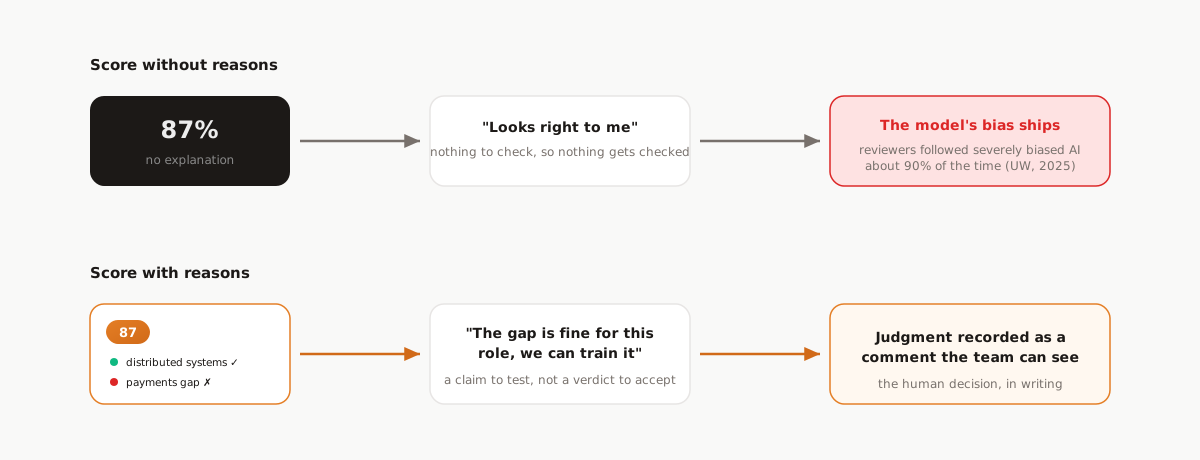
Then in 2025, the same group ran the experiment that should end the "human-in-the-loop solves it" argument. In a 528-participant study, reviewers picking between equally qualified candidates chose evenly when they had no AI input, or neutral AI input. When the AI's recommendations were severely biased, reviewers followed them roughly 90 percent of the time. As lead author Kyra Wilson put it: "Unless bias is obvious, people were perfectly willing to accept the AI's biases."
Two honest hedges before you quote that number at a dinner party. The study used online participants in a simulated task, not professional recruiters reviewing real pipelines. And the widely cited companion statistic, that around 80 percent of organizations using AI hiring tools say they never reject an applicant without human review, comes from a ResumeBuilder survey rather than an audit. But the direction of the finding is hard to argue with, and it matches what anyone who has stared at a ranked list already suspects: a bare score does not invite scrutiny. It invites agreement.
Why "a human reviews everything" is not enough
Put the two UW findings together and the standard industry reassurance falls apart. The models can be biased, and the humans reviewing them tend to mirror whatever the model says. A rubber stamp is still a rubber stamp when a person is holding it.
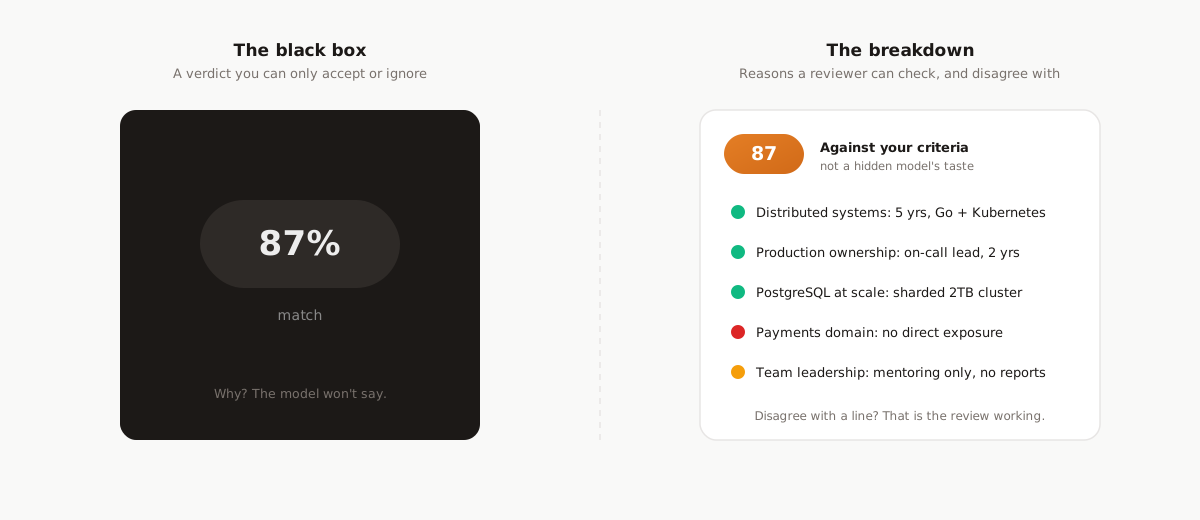
The problem is structural. When a screening tool outputs "87% match" and nothing else, the reviewer has nothing to engage with. There is no claim to verify, no reasoning to challenge, no place where their expertise gets traction. The path of least resistance is to nod. And under a pile of 400 applicants, everyone takes the path of least resistance.
What trustworthy AI screening actually looks like
The fix is not removing the AI, and it is not adding a second sign-off. It is changing what the AI hands to the human. Three properties matter:
1. Criteria you wrote, not taste the model learned. Amazon's model went wrong because it learned what "good" meant from historical hires. A trustworthy scorer never gets to define "good." Your team writes the must-haves and nice-to-haves for the role; the model's only job is to check resumes against that list. If the criteria are biased, they are at least visible, written in plain language, and fixable by editing a document instead of retraining a model.
2. Reasons, not verdicts. A score should come with its work shown: which criteria matched, which are missing, what the evidence was. The breakdown converts the reviewer's job from "do I trust this number?" into "is this specific claim about this specific resume true?" That is a question a human can actually answer, and disagreeing with one line of a breakdown is a much smaller act than overruling a confident-looking percentage.
3. A place where human judgment gets recorded. If a reviewer disagrees with the machine, that disagreement should become part of the candidate's record, visible to the whole team, not a private mental note that evaporates. Judgment that is written down compounds; judgment that is not gets re-derived by the next reviewer, or lost.
How Reordinal implements this (and where the line is)
Reordinal scores every applicant against the job's criteria, the ones you wrote into the job description. Every score ships with its breakdown: matched criteria, missing criteria, strengths, and concerns, per candidate. Reviewers sort by score to decide where to start reading, open the breakdown and the parsed resume to check the machine's claims, and record their verdicts as team comments on the candidate.
The line we hold: the score orders the pile, people make the call. There is no auto-reject in Reordinal. A low-scored candidate is still in the list, still parsed, still one click from a human's eyes, which also means the long tail of applicants gets a floor of attention that a tired human skimming page 14 was never going to provide.
Held to the standard above, that is the honest pitch: not "our AI is unbiased," which nobody can promise, but "our AI shows its work, on your criteria, and never decides." That is the version of AI screening the research says you can actually supervise.
Disagreeing with the score is a feature
The deference research says reviewers rarely push back on a machine's number, so a trustworthy system has to make pushing back easy, visible, and durable. Two mechanisms in Reordinal exist for exactly that.
First, the reviewer score override. If you read the breakdown and the resume and conclude the machine got it wrong, you set your own score on the candidate, with a note explaining why. From then on, sorting uses your score, not the AI's, and the override carries an audit trail: who set it, when, and their reasoning. The disagreement is not a private grumble; it reorders the pipeline and stays on the record. Watching where overrides cluster also tells you something the score never will: if you keep correcting the same kind of candidate upward, your criteria need editing.
Second, provenance on judgments. Comments written by a person and assessments drafted through our Claude Code plugin live in the same thread, but plugin-written comments carry a visible marker. Nobody mistakes AI-drafted analysis for a teammate's verdict, which matters for the same reason the deference study matters: you cannot calibrate your trust in an opinion if you do not know where it came from.
Both mechanisms are small. That is the point. Human-in-the-loop fails as a slogan and works as plumbing: give the human a lever that actually moves the pipeline, and a record that outlives the meeting.
The takeaway
Distrust of black-box resume screening is not technophobia; it is the correct reading of the evidence. But the answer is not going back to gut-feel skimming, which has its own well-documented biases and no audit trail at all. The answer is AI that argues its case instead of announcing a verdict, in front of humans who keep the decision. If you are evaluating any screening tool, including ours, ask one question first: when it scores a candidate, can I see why, and can I disagree on the record?
Frequently asked questions
Does AI resume screening automatically reject candidates?
Some tools do, and that is where the documented harms concentrate: the iTutorGroup case was automated rejection by rule. In Reordinal there is no auto-reject; scores order the list, every candidate stays visible, and rejection only happens when a person decides it.
Is AI resume screening legal?
Generally yes, but discrimination law fully applies to automated decisions: the EEOC pursued iTutorGroup for automated age-based rejection, and jurisdictions like New York City add audit and notice requirements for automated hiring tools. Tools that score transparently and leave decisions to humans carry far less risk than auto-rejection. This is not legal advice; check the rules where you hire.
How accurate is AI resume screening?
Accuracy depends on what you ask it to do. Research shows models ranking resumes on learned preferences can encode significant name-based bias, which is why checking resumes against explicit, human-written criteria and showing per-criterion evidence is the defensible design: every claim the model makes can be verified against the resume.
What does human-in-the-loop mean in hiring?
In practice, often just a sign-off, and research on deference shows reviewers follow biased AI recommendations about 90 percent of the time when given bare scores. Meaningful human-in-the-loop requires reasons a reviewer can check, the power to override the score on the record, and human-only control of rejection.
Can I override an AI resume score?
In Reordinal, yes. A reviewer can set their own score with a note explaining why; sorting then uses the human score, and the override records who set it and when. Clusters of overrides are also a signal that the job criteria themselves need editing.