
In any given quarter, 18 to 22% of the jobs posted on the Greenhouse platform are classified as ghost jobs, according to Greenhouse's 2024 State of Job Hunting report. Three in five candidates say they suspect they have encountered one. So a meaningful slice of the people reading your very real job post are quietly asking a question that would have sounded paranoid a decade ago: does this job actually exist?
LinkedIn's answer to that question is a verification badge for job posts, currently in pilot. It is a good idea, and you almost certainly will not have it for a while. This post covers what the badge actually attests, why waiting for it is the wrong move, and the trust signals a small company can stack today that do most of the same work.
The trust gap you are posting into
Candidate skepticism is not a mood; it is a learned response to how hiring has behaved. The same Greenhouse report found that 61% of job seekers have been ghosted after a job interview. Add stale posts that stay up long after the role is filled, listings created to harvest resumes for a pipeline that does not exist, and outright scam posts imitating real companies, and the rational candidate posture becomes: assume a post might be fake until something proves otherwise.
That posture costs you real applicants. The people with options, the ones fielding several processes at once, are exactly the ones most likely to skip a post that smells unattended. They are pattern-matching for signs of life: a real person behind the post, real detail about the work, evidence that applying leads anywhere. Transparency has stopped being a nicety; Indeed's Hiring Lab lists it, alongside flexibility, as an emerging key differentiator for attracting workers in 2026.
The trust gap, in other words, is not your fault, but it is your problem. Every legitimate small company posts into a pool polluted by companies that were not.
What the verification badge actually attests
According to LinkedIn's current documentation, a verification badge on a job post means two specific things: the company has a verified LinkedIn Page, and the individual who posted the job has verified that they work there. That is the whole claim. It is identity verification, not quality review.
Two more details matter. The badge cannot be bought or paid for; it is independently assessed and granted by LinkedIn. And as of mid-2026 it is being piloted with a select number of LinkedIn Jobs customers, which tells you who gets it first.
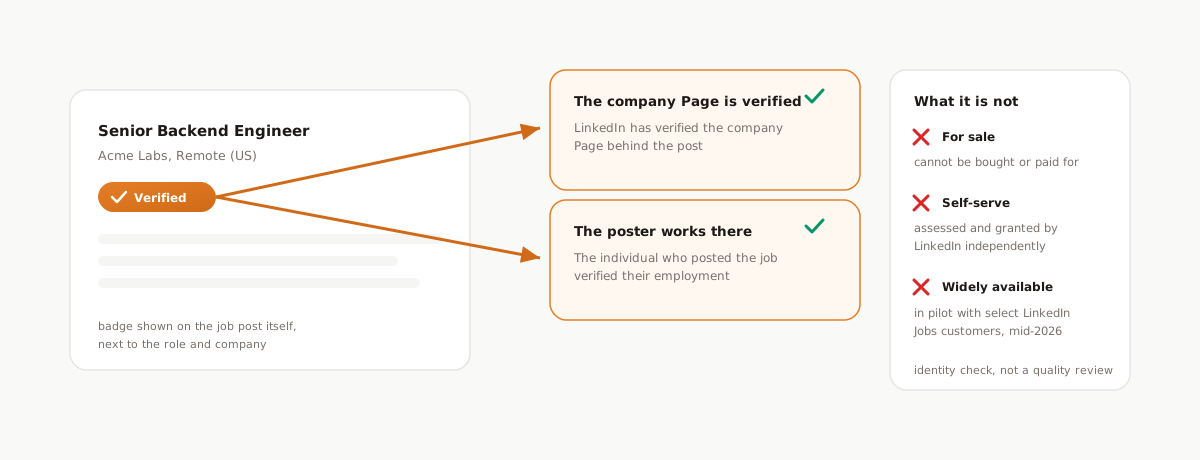
Notice what the badge does not say. It does not say the salary is real, the role is still open, the process is respectful, or that anyone will ever read your resume. It narrows one specific risk, "this company is not who it claims to be," and leaves every other trust question exactly where it was. That is not a criticism; verified identity is the right foundation. But it means the badge is a floor, not a ceiling, and the rest of the trust stack was always going to be your job anyway.
The badge program is a pilot, and pilots change: eligibility, rollout, and even the badge itself may look different by the time you read this. Check LinkedIn's current documentation before assuming anything here still holds, and be wary of anyone offering to get you verified for a fee. LinkedIn states the badge cannot be bought.
Why waiting for the badge is the wrong move
If the pilot is running with a select set of LinkedIn Jobs customers, the badge will reach enterprise recruiting teams long before it reaches a founder posting one free job. You could read that as unfair. The more useful reading: for the next stretch of time, verification will make unverified posts look worse by contrast, and small companies will carry that penalty precisely when they can least afford it.
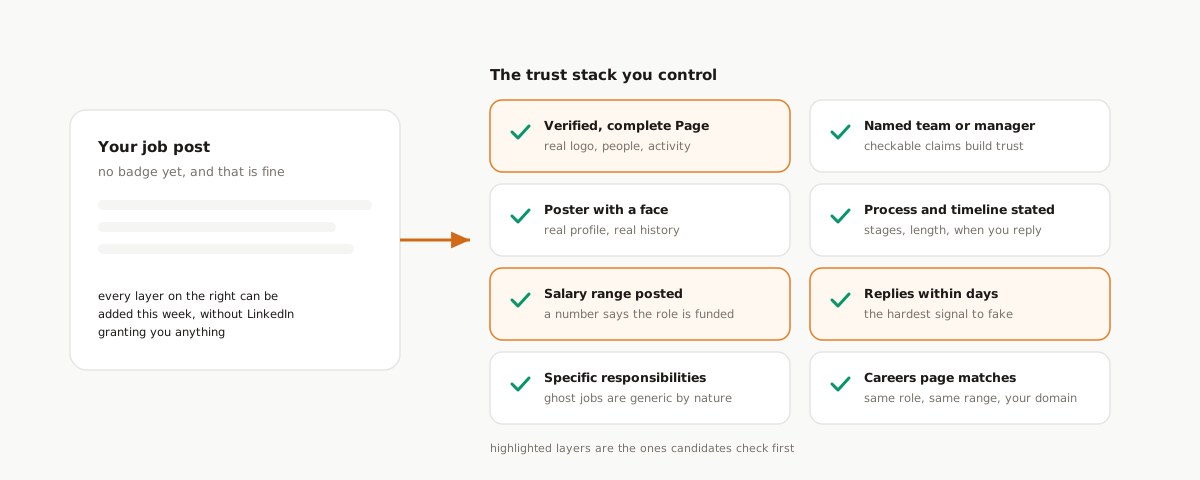
Which is why the play is not to wait. Everything the badge signals, "a real company, a real person, a real process," can be demonstrated through channels you already control. Candidates were reading those signals long before LinkedIn started formalizing them. Stack enough of them and your post reads as legitimate with or without a checkmark.
The eight trust signals you control today
Here is the stack, roughly in order of how hard each is to fake, which is also roughly how much candidates trust it.
A verified, complete company Page. The badge is built on Page verification, and the Page is the first thing a skeptical candidate opens. A Page with a real logo, a specific description, employees who list the company on their profiles, and recent activity answers the existence question before it gets asked. An empty shell Page does the opposite, badge or no badge.
A poster with a face and a history. Post the job from a real profile, yours or the hiring manager's, not a barely populated recruiter account created last month. Candidates click through to whoever posted. A profile with years of history, mutual connections, and posts about the actual work is the single strongest "a human is on the other end" signal available to a small company.
A salary range in the post. Nothing says "this is a real, funded role" like a number. Appcast's current data shows jobs that include salary information consistently receive more clicks and higher apply rates, and often a lower cost per application. Secrecy reads as either disorganization or a trap, and candidates have seen enough of both.
Specific responsibilities. Ghost jobs are generic by nature, since nobody bothers writing real detail for a fake role. So specificity is credibility: what this person will own, what the stack is, what the first project looks like. If you started from LinkedIn's AI draft, this is exactly the substance the draft cannot contain, because the generator never saw it.
A named team or manager. "You will report to our head of engineering, who joined from X" beats "join our dynamic team." Names are checkable, and checkable claims are the currency of trust.
A stated process and timeline. Three sentences: what the stages are, how long the whole process takes, when applicants hear back. Almost nobody does this, which is why it stands out. It also commits you to behavior worth committing to.
Responses within days, visibly. Candidates compare notes on response times more than you think. A post that has been up for weeks with no evidence anyone reviews applications drifts into presumed-ghost territory regardless of intent.
A careers page that matches. If the role is real, it exists on your site too, with the same title and range. A LinkedIn post with no corresponding page on your own domain is a classic scam pattern, and candidates know it.
Run your current post through the checklist below and see which verdict band it lands in, then fix the highest-weight signal you are missing.
Trust signal audit
Check each signal your current job post already has.
A heuristic for self-review, not LinkedIn’s algorithm. Weights reflect how hard each signal is to fake, not any published formula.
Most posts score lower than their authors expect, usually on the signals that cost words rather than money: the named manager, the process timeline, the range. Those are one edit away.
The signal you can only send after applicants arrive
Seven of the eight signals live in the post itself. The eighth, responsiveness, is a behavior, and it is the one candidates weight most heavily because it is the hardest to fake. It is also where lean teams fail by default: applications pile up inside LinkedIn, review keeps sliding to next week, and silence does the reputational damage that the other seven signals were built to prevent. Remember the number this post opened with: 61% of candidates have been ghosted after an interview. The bar for standing out is genuinely low.
Speed needs a system, not intentions, especially since a free post does most of its work in a short window. The mechanics: export your Easy Apply applicants out of LinkedIn with the Reordinal Chrome extension, resumes and screening answers included, as they arrive rather than at the end. Parsing and AI scoring against your role criteria give you a reading order the same day, so the first meaningful human decisions happen within days of posting, not weeks. And when you advance some candidates and pass on others, email templates with per-candidate tokens and bulk send make closing the loop a ten-minute task instead of a guilt pile. We wrote a full playbook on rejecting without ghosting; the short version is that a prompt, honest no is a trust signal your next posting inherits.
That is the quiet compounding effect: candidates talk, reviews get written, and the runner-up you answered quickly this quarter applies again next quarter. Responsiveness is the only signal on the list that gets cheaper the better your tooling is.
Legitimacy is a stack, not a badge
The verification badge will eventually reach small companies, and when it does you should take it: verified Page, verified poster, done. But the badge was never the moat. It confirms you exist; the other signals convince a good candidate that applying is worth their time. Companies that stack them now will convert better today and will look strongest later, when a badge sits on top of a post that already earned the trust it certifies.
Frequently asked questions
What does the verification badge on a LinkedIn job post mean?
Per LinkedIn's documentation, it means the company has a verified LinkedIn Page and the individual who posted the job verified that they work there. It is identity verification by LinkedIn, not a review of the job's quality, salary, or hiring process.
Can I buy or apply for LinkedIn job post verification?
No. LinkedIn states the badge cannot be bought or paid for; it is independently assessed and granted by LinkedIn. As of mid-2026 it is being piloted with a select number of LinkedIn Jobs customers, so treat any third party selling verification as a scam.
What is a ghost job and how common are they?
A ghost job is a posting for a role the company is not actually filling, left up stale or created to collect resumes. Greenhouse's 2024 State of Job Hunting report classified 18 to 22% of jobs posted on its platform in a given quarter as ghost jobs, and three in five candidates say they suspect they have encountered one.
How do I make my LinkedIn job post look legitimate without a badge?
Stack the signals you control: a complete and verified company Page, posting from a real profile with history, a salary range, specific responsibilities, a named manager, a stated process timeline, fast responses to applicants, and a matching listing on your own careers page.
Does responding to applicants quickly really matter?
Yes. Greenhouse found 61% of job seekers have been ghosted after an interview, so responsiveness is rare enough to be a differentiator. It is also the trust signal candidates weight most, because it cannot be faked in the posting itself.