
Across 56 countries, LinkedIn's Economic Graph team ran a simple counterfactual: for any given job, what happens to the pool of eligible candidates if you consider people who hold at least half of the job's top skills, instead of only people who have already held the job title? Their skills-based hiring report from March 2025 puts the median answer at 6.1x. Rewrite one section of your job post and the set of people who plausibly qualify for it multiplies by six.
For a founder posting a role, that is about as close to free reach as hiring offers. No promotion budget, no policy gray area, no trick that stops working next quarter. The gain also tilts toward exactly the people degree filters exclude: workers without a bachelor's degree gain 6% more reach under skills-based eligibility than degree holders do, 6.3x versus 5.9x.
But the number measures who could qualify, not who applies, and certainly not who gets hired. Researchers who tracked companies after they publicly dropped degree requirements found that actual hiring changed far less than the postings did. So this post covers both halves honestly: how to claim the reach, and how to make your screening convert any of it into hires. The first half takes twenty minutes. The second half is where most companies quietly fail.
What the 6.1x actually measures
LinkedIn's method is worth understanding, because it tells you where the reach comes from. For each job, the Economic Graph team compared two definitions of eligible: people who have held the job's title before, and people who hold at least half of the job's top skills, whatever their title history. Across 56 countries, the second definition produces a median talent pool 6.1 times the size of the first.
Two things follow from the method. First, the expansion is theoretical. It counts people who could credibly do the work, not people who will see your post or click apply. LinkedIn is explicit that this is pool expansion, not realized hires. Second, the constraint it removes is one you wrote. Nobody forces a "bachelor's degree required" line or an exact-title mentality into your post; that boilerplate gets pasted forward from the last job description, and it quietly excludes career changers, bootcamp graduates, veterans, and everyone whose resume says "platform engineer" when you searched for "backend engineer."
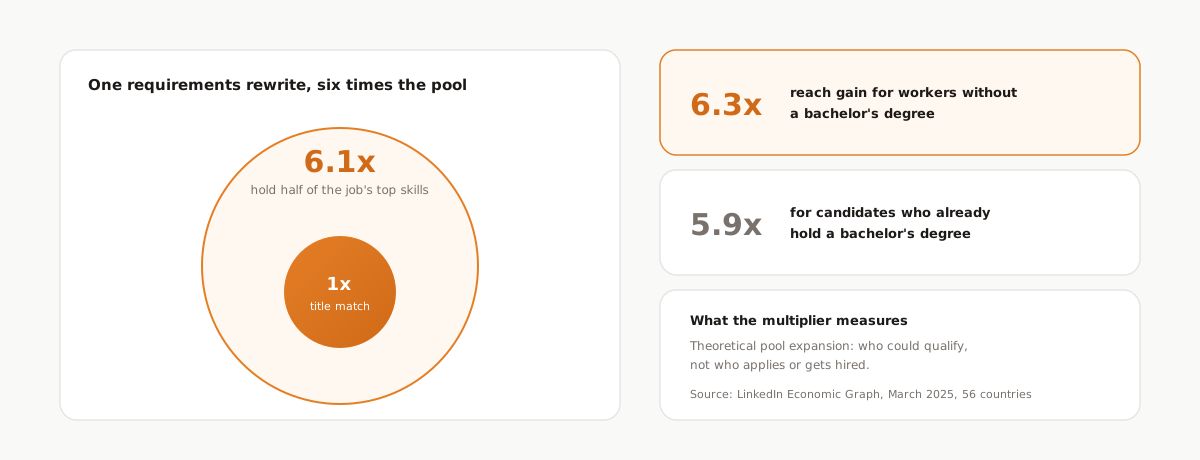
The degree split deserves a sentence of its own. Workers without a bachelor's degree gain slightly more reach than degree holders when eligibility is defined by skills, which means the degree line in your post is not a neutral quality bar. It is a filter that mostly removes people the skills data says could do the job, while barely inconveniencing the credentialed candidates you were never worried about.
To see what the multiplier means at your scale, set a baseline pool below and toggle between the two requirement styles.
Talent pool expander
Pick a baseline pool, then switch the requirement style to see how far skills-based eligibility reaches at your scale.
Eligible by degree + title
500
Eligible by half of top skills (6.1x median)
3,050
Workers without a bachelor's degree gain slightly more reach than degree holders: 6.3x versus 5.9x.
Reach is not hires. The wider pool only changes your shortlist if the screening evaluates the skills you asked for.
Based on the LinkedIn Economic Graph skills-based hiring report, March 2025: median expansion across 56 countries. Modeled theoretical eligibility, not a guarantee of applicants or hires.
The follow-through gap: postings change, hiring mostly does not
Now the uncomfortable half. In 2024, the Burning Glass Institute and Harvard Business School published "Skills-Based Hiring: The Long Road from Pronouncements to Practice," a study of what actually happened at large firms that removed degree requirements from their postings. In the roles where requirements were dropped, hiring of candidates without degrees rose by about 3.5 percentage points. Spread across the whole market, the effect amounted to fewer than 1 in 700 hires. And nearly all of the genuine change was concentrated in roughly 37 percent of the companies studied: the ones that changed how they evaluate candidates, not just what the ad said.
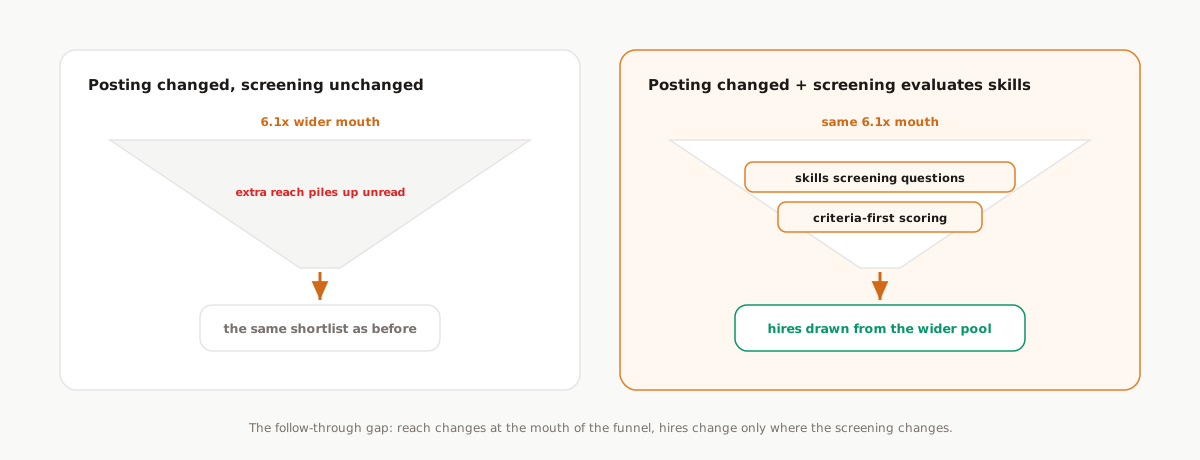
Read those numbers next to LinkedIn's 6.1x and the diagnosis writes itself. The reach expansion is real and immediate. The hiring change is rare, because most companies edited the posting and left the evaluation machinery alone. Recruiters kept screening on the same pedigree proxies, resumes kept getting skimmed in seconds, and the shortlist came out looking exactly like last year's shortlist. The wider pool applied, got filtered by habit, and went home.
For a lean team this is quietly good news. The follow-through gap is a story about large organizations failing to change ten years of process. You do not have a talent acquisition department with entrenched habits; you have one job post and whatever screening method you pick this week. At your size, closing the gap is a decision, not a change program.
Claim the reach: rewrite the requirements around real skills
The posting half is straightforward, and worth doing precisely.
Name three to five skills the work actually uses. Not a keyword dump of every tool in the stack. If the job is shipping a React product, the skills are React, TypeScript, and taking features to production; the rest is training data. For each skill, state the depth you mean: "has run Postgres in production" separates candidates in a way "database experience" never will, and it gives you something concrete to screen against later.
Drop the degree line unless it is genuinely required. Some roles carry licensure or regulatory reasons for a credential. Most startup roles do not, and the line survives on inertia. Deleting it is the single edit that LinkedIn's data says most expands who can see themselves in the role.
Keep the title short and literal. Appcast's current job ad data shows titles of 4 to 6 words deliver the strongest apply rates, with rates dropping past 10 words. Appcast's network skews toward high-volume hiring, so treat the exact numbers as directional, but the principle holds everywhere: a skills-forward post does not need a clever title, it needs the words candidates actually search.
Say how you work and how you hire. Indeed's Hiring Lab 2026 trends research finds flexibility and transparency emerging as key differentiators for attracting workers. Remote and hybrid specifics, plus one plain sentence about your interview process, do more for a skills-based post than another paragraph of mission language.
One warning about the tool that offers to write all of this for you: LinkedIn's AI draft is generated from five fields: title, location, company, workplace type, and job type. It cannot know your real skills list, so the requirements section is exactly the part you must write yourself.
A caveat before you delete the degree line: reach multiplies, signal does not. The wider pool contains more strong career changers and more unqualified one-click applies, in proportions you cannot see from the posting side. If your screening cannot tell them apart, the 6.1x shows up as an unread pile, not a better shortlist.
Make the screening evaluate the skills you asked for
This is the half that separates the 37 percent from everyone else, and for a small team it comes down to three moves.
Ask screening questions about the skills, at publish time. Easy Apply screening questions can carry the load the degree line used to pretend to carry. "How many years have you run Kubernetes in production?" is a skills question with a sortable answer. Prefer numbers and yes/no over prose, and ask about the same three to five skills you put in the requirements, so the post and the screen are one system.
Write the criteria before you read a single resume. Your skills list is the criteria. Write it down as must-haves and nice-to-haves, with the depth you expect, exactly as the triage playbook prescribes. Skills-based screening fails when "we evaluate skills" means "I skim for vibes with a different vocabulary." A written list is what keeps the evaluation honest when the pile gets deep.
Expect volume and plan the first pass. Easy Apply already produces volume without much signal by design, and apply rates surged during 2025 even as recruitment costs rose, per Appcast's 2026 benchmarks. A 6.1x-reach post amplifies both. If the first pass over the pile is not systematic, fatigue will reinstate the degree filter through the back door: at second forty of a manual skim, a familiar school name is the easiest pattern to match, and you are back to hiring by pedigree while your job post promises otherwise.
What this looks like after the applicants arrive
This follow-through problem is the part of hiring Reordinal was built around. The skills you wrote into the post become the scoring criteria: every imported resume is parsed and scored against exactly that list, with a per-criterion breakdown showing the evidence found for each skill, what matched, and what is missing. A career changer whose resume says "self-taught, three production Rails apps" scores on the Rails criterion whether or not any degree or title matches, which is the promise of the 6.1x pool made operational.
The screening answers come along too. If you asked skills questions on the LinkedIn post, they arrive as list filters, so "three or more years of production Kubernetes" narrows the pile before anyone opens a resume, and the score orders whatever remains. Your team reviews the top slice, records verdicts, and the wider pool becomes a wider shortlist instead of a wider backlog. None of this auto-rejects anyone. Scores set the reading order and humans make the calls, which is the standard you owe a pool six times larger than the one you used to invite.
The honest version, in one paragraph
Drop the degree line unless you can defend it. Rewrite the requirements as three to five concrete skills with stated depth. Keep the title plain and searchable. Then, and this is the step that decides whether you join the 37 percent, make the evaluation match the posting: skills questions at publish, criteria written before the first resume, scoring and filters that read evidence instead of pedigree. LinkedIn's data says the pool will be 6.1x bigger. The Burning Glass data says what you do next determines whether that means anything at all.
Frequently asked questions
Does removing degree requirements from a job post get more applicants?
It expands who is eligible: LinkedIn's Economic Graph finds that skills-based eligibility grows the talent pool by a median of 6.1x across 56 countries. That is theoretical reach rather than guaranteed applications, but a degree line does measurably shrink who can see themselves in the role.
What is skills-based hiring on LinkedIn job posts?
It means defining eligibility by the skills the work requires, typically three to five concrete skills with stated depth, instead of by degrees or exact previous job titles. It covers how you write the requirements and, just as importantly, how you screen the applicants afterward.
Why doesn't dropping degree requirements change who gets hired?
Research from the Burning Glass Institute and Harvard Business School found hiring changed far less than postings did: fewer than 1 in 700 hires shifted, and nearly all real change came from the minority of companies that also changed evaluation. The posting is necessary but the screening decides.
Should a startup require a bachelor's degree in job descriptions?
Only when the role genuinely requires a credential, for licensure or regulatory reasons. Otherwise the degree line mostly filters out people LinkedIn's skills data says could do the job, and workers without degrees gain slightly more reach (6.3x versus 5.9x) when it goes.
How do you screen candidates for skills instead of degrees?
Ask screening questions about the specific skills at publish time, write must-have criteria before reading any resumes, and score every applicant against those criteria. In Reordinal, parsed resumes are scored against your skills list with per-criterion evidence breakdowns, so proof of skill outranks pedigree.