
You posted one role. Two weeks later you have 400 applicants, a day job, and a quiet, growing certainty that most of those resumes will never be opened. This post is the triage method for exactly that situation: how a one-founder or three-person hiring "team" gets through hundreds of Easy Apply applicants with their standards, and their week, intact.
(If your applicants are still trapped inside LinkedIn, start with our export guide, then come back. That post is the mechanics; this one is the method.)
The volume is not your imagination
Application volume has structurally changed. Greenhouse's benchmark data shows applications per job posting up 111 percent between 2022 and 2025, and Ashby's data shows applications per hire roughly tripling from 2021 to 2024. One-click applying did what one-click anything does: it removed the friction, and volume filled the space.
The result, as HR consultant Michael Trust put it in HR Daily Advisor: "People can apply without much thought at all, and so recruiters are overwhelmed with applications," to the point where "it would be virtually impossible for them to manually sort through all of these." And that is a verdict about professional recruiters. A founder screening between investor calls has less time, not more.
Why brute force fails (even when you try hard)
The naive plan is always the same: block a weekend, open the pile, be fair. Here is what actually happens.
Seconds, not minutes. At high volume, practitioners report skimming applications in single-digit seconds each. That is not review; it is pattern matching on resume formatting, school names, and whatever your eye lands on first, which is precisely the gut-feel bias people worry AI will introduce, already operating at full strength with zero audit trail.
Fatigue ordering. Candidate #12 gets a careful read. Candidate #212 gets whatever attention is left after three hours. Your evaluation standard is a function of queue position, which is a random variable. The best candidate in the pile might simply have applied on the wrong day.
No memory. You shortlist eight people, feel productive, and next week your co-founder asks "what about that person with the Stripe background?" Nobody remembers. Nothing was written down. The review has to happen again.
Brute force does not fail because you are lazy. It fails because reading 400 resumes attentively is roughly a week of full-time work, and nobody has that.
The playbook
The method has six steps, and the order matters more than the tooling.
1. Write the criteria before opening a single resume
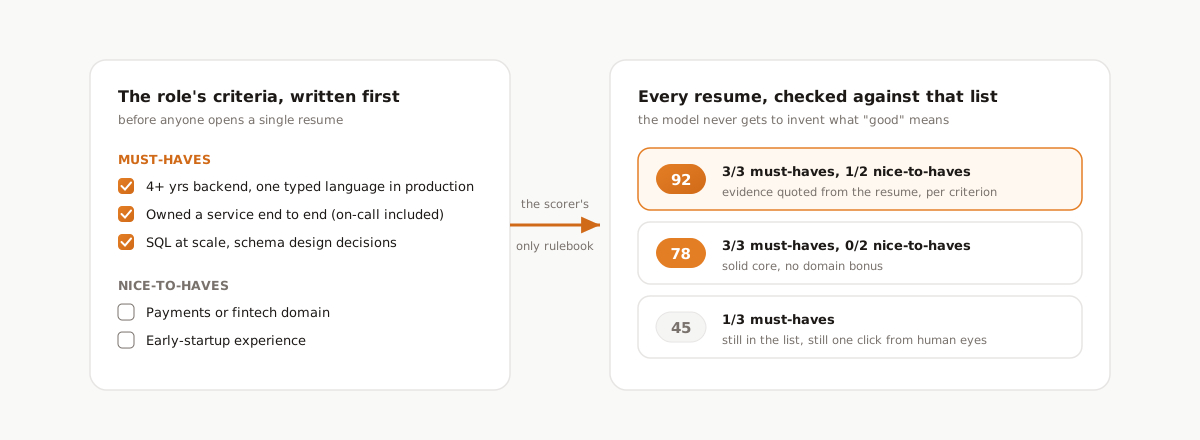
Sit down with whoever owns the hire and write two short lists: must-haves (the role fails without them) and nice-to-haves (tiebreakers). Be concrete: "4+ years of backend work with a typed language in production" beats "strong engineer." Fifteen minutes, one document.
This is the step everyone skips, and it is the one doing the real work. Criteria written before you see resumes are your definition of the job. Criteria improvised while skimming are a rationalization of whoever you just happened to like. Every later step depends on this list existing.
2. Get everyone into one list, resumes attached
Triage is impossible across three surfaces (LinkedIn's applicant panel, an email folder, a spreadsheet). Consolidate: every applicant in one place, with their actual resume attached, not a link that dies. If your volume comes from LinkedIn Easy Apply, the Chrome extension does this in batches, screening answers included.
3. Let scoring do the first pass, and start at the top
This is where the week of reading collapses into an afternoon. In Reordinal, every imported resume is parsed and scored against the criteria you wrote in step 1, with a per-criterion breakdown showing what matched, what is missing, and the evidence. Sort descending. Your review now starts with the candidates most likely to be worth your attention, instead of with whoever applied first.
Before the score even enters it, the answers candidates gave you are filters. If your LinkedIn job asked screening questions, those answers came across with the import, and "work authorization yes, notice period 30 days or less" is a two-click filter that stacks with the score sort. Structured facts narrow the pool; the score orders what remains.
To be clear about what the score is: it is a reading order, not a decision. We have written at length about what makes AI screening trustworthy; the short version is that scores rank, breakdowns show their work, and humans decide. Nothing in this playbook auto-rejects anyone.
4. Time-box the human pass and write your verdicts down
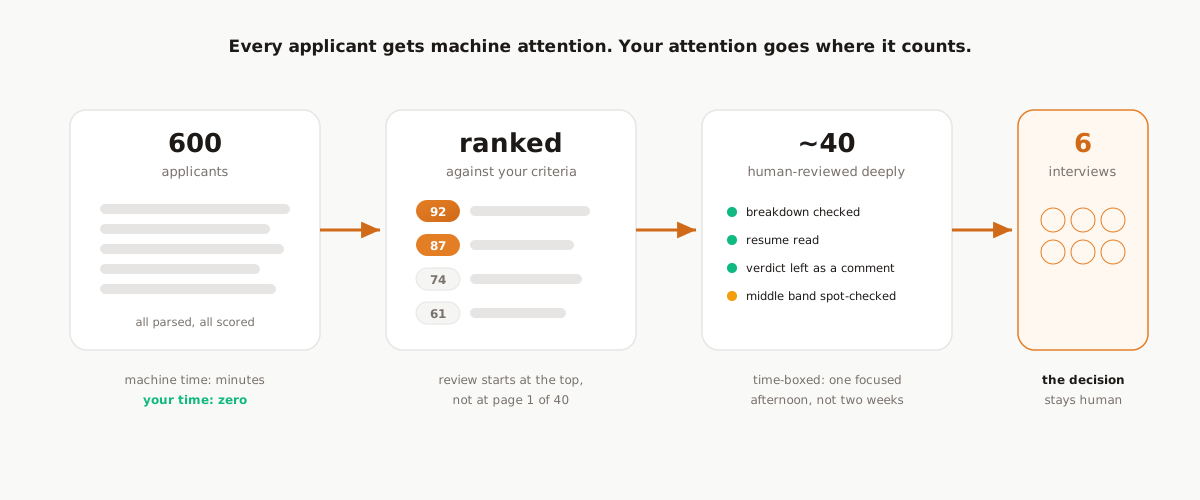
Take the top slice (say, 40 for a role you will interview 6 people for) and give each one a real review: read the breakdown, open the parsed resume, check the screening answers. Then record the verdict as a comment on the candidate: "strong, probe payments gap," "no, seniority mismatch," two lines max.
The comments are what kill the no-memory problem. Your co-founder sees your verdicts instead of re-reviewing, disagreements surface early and in writing, and when the candidate asks for feedback in three weeks, you have some. If you use our Claude Code plugin, Claude can draft these assessments from the resume and breakdown, and save them as comments after you approve the text.
5. Keep the long tail honest
The 360 candidates you did not deep-review still got parsed and scored, which is a floor of attention that fatigue-ordered skimming never provides. Spend the last 30 minutes on honesty checks: skim the middle band for candidates the criteria might undervalue (career changers, unusual paths), and spot-check a few low scores to confirm the criteria are not quietly wrong. If a spot-check surprises you, fix the criteria and re-score; that is a two-minute change, not a weekend redo.
6. Close the loop with everyone
Triage is not finished when the interview list exists; it is finished when everyone knows where they stand. The verdicts you recorded in step 4 make this mechanical: the interview list gets a scheduling-link email so candidates book their own slots, and the people you passed on get a stage-appropriate rejection in one bulk send, with per-candidate previews and protection against double-sending. We wrote a separate playbook on rejecting without ghosting; the short version is that closing the loop costs about ten minutes once the verdicts exist, and the runners-up you treat well become next role's warmest pipeline.
What not to automate
The interview list. The playbook compresses reading, because reading scales badly and machines are good at it. It deliberately does not compress deciding, because a hire is a high-stakes call about a person, and the research on automated rejection is a catalog of cautionary tales. The machine orders the pile; you choose from it.
Run this once and the math changes permanently: 400 applicants stops meaning "we will review until we burn out" and starts meaning one afternoon of focused human judgment, applied where it counts, with a written record your team can build on.
Frequently asked questions
How long does it take to screen 500 resumes?
Read attentively, 500 resumes is roughly a full week of work, which is why it rarely happens. With criteria-based scoring doing the first pass, the same pool becomes minutes of machine time plus one focused afternoon of human review on the top slice.
How do recruiters screen hundreds of applicants quickly?
At volume, manual screening collapses to single-digit seconds per resume, which is pattern matching, not review. The scalable alternative is written criteria, structured filters like screening answers, ranked scoring to set reading order, and time-boxed human review with recorded verdicts.
What percentage of applicants should you interview?
There is no magic ratio, but a workable rule for lean teams is to deep-review roughly five to ten times the number you will interview, and interview five to eight for one hire. For 400 applicants and 6 interview slots, that means a careful human pass on about 40 people.
Do I need an ATS to hire for one role?
You need three things a spreadsheet does badly: every applicant in one place with their actual resume, a defensible first-pass ordering, and a shared record of who reviewed whom. If email and a spreadsheet are giving you those at your volume, keep them; at hundreds of applicants they usually break.
How do small teams split resume review without duplicating work?
Record verdicts where the next person will see them. In Reordinal, each reviewed candidate gets a short comment with the verdict and reasoning, so a co-founder continues from the recorded judgments instead of re-reviewing the same resumes.