
Appcast's 2025 Recruitment Marketing Benchmark Report measured what happens after a job seeker clicks a job ad. When the click led to a short, one-click flow like LinkedIn's Easy Apply, 19.37 percent of clicks became completed applications in 2024. When it led to a long, ATS-hosted application, the median apply rate was 6.1 percent.
Same role, same click, roughly three times the applicants. The difference is not your job description or your employer brand. It is the number of steps between "interested" and "submitted."
That trade has a name: volume for signal. Easy Apply hands you the volume automatically. The signal you have to go and get. This post is about doing both on purpose, instead of getting one by default and mourning the other.
The volume is the design working
One-click applying removes every reason to stop mid-application. No account creation, no re-typing the resume into form fields, no upload step on a phone that does not have the file. Appcast's job ad content data shows the same mechanic from the other side: jobs with apply flows that take 1 to 5 minutes convert far better than jobs demanding 10 or more minutes. Friction is the variable; everything else is noise.
And the baseline keeps rising. Appcast's 2026 benchmark report, built on roughly 1,200 employers, 302 million job ad clicks, and 27 million applications, found apply rates surged during 2025 even as recruitment costs rose in a softer labor market. The 2025 report saw the same direction inside long flows too: that 6.1 percent median was itself up about 35 percent over 2024. More of every click becomes an application, everywhere, and the one-click formats start from a base three times higher.
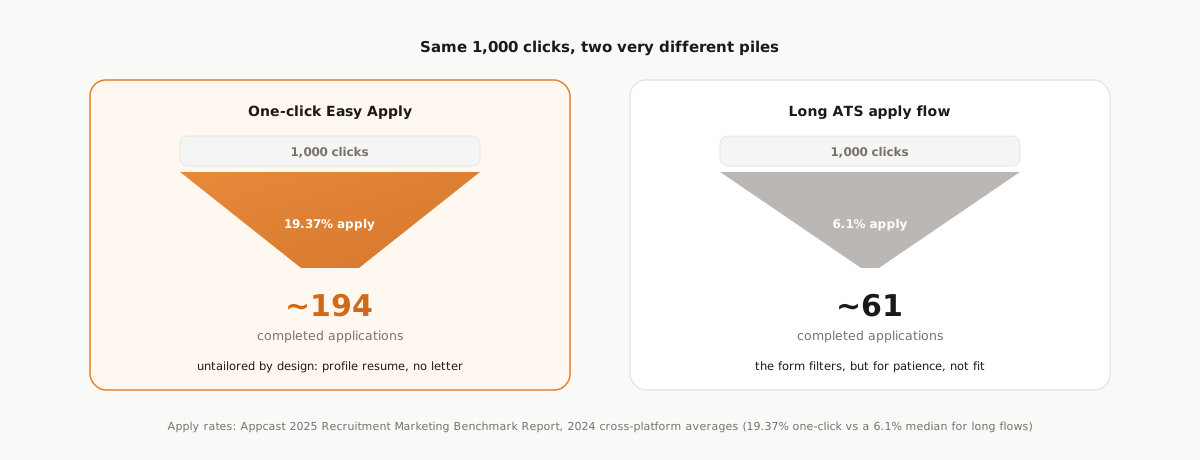
So when your LinkedIn post collects hundreds of applicants in its first week, that is not a broken filter. That is the product doing exactly what it was built to do, and the pile lands fast: applications cluster early in a post's life, a pattern we break down in the first 10 days of a LinkedIn job post.
What the one-click application does not carry
Here is the cost side of the trade. A one-click application is, almost by definition, untailored. The resume is whatever PDF was already attached to the candidate's profile. There is no cover letter, no reordering of experience for your role, no answer to "why this company." The click costs the candidate nearly nothing, which is precisely why you get so many of them and why each one tells you so little.
Appcast says this themselves in the 2025 report: the easier apply method wins on volume, but employers must verify it still produces quality candidates. The old, miserable long-form ATS application was doing a job you may not have noticed: it was a self-selection filter. Only candidates with real intent finished it.
It was a terrible filter, though. It selected for patience, free time, and desktop access, not for fit. The strongest candidate in your market, employed and busy, is exactly the person who abandons a 10-minute form and clicks Easy Apply on the next role. Losing the accidental filter is fine. What you cannot do is pretend you still have one.
The tempting fix makes it worse
The instinct, once the pile arrives, is to add friction back: a longer form, an essay question, a portfolio upload, "please also apply on our careers site." Two data points argue against it.
First, conversion collapses non-linearly. The gap in Appcast's data is not between 5 minutes and 6 minutes; it is between the 1-to-5-minute flows and the 10-plus-minute flows. You will not trim the pile at the margin. You will cut it to a fraction and lose strong candidates along with weak ones, indiscriminately.
Second, a large share of applying happens on phones, where extra steps hurt most. In Appcast's 2025 report, mobile's share of completed applies was 83.21 percent for gig roles and 82.80 percent in food service; even in technology, the most desktop-heavy category, it was 25.55 percent. Appcast's advice follows directly: cut long screening questions on mobile, and do not require documents job seekers will not have on their phones. A portfolio-upload wall is a desktop-only application in disguise.
One caveat on all of these numbers: Appcast's network skews toward high-volume and hourly hiring, so treat the exact percentages as directional for a niche startup role rather than a prediction. The shape of the trade, easier apply means more volume and less signal per applicant, is the durable part.
The math of the trade is easier to feel than to read. Drag the slider to your expected click volume and watch what each funnel hands you, and what happens when a human can only deep-read 25 resumes.
Volume vs signal, at your click count
Drag the slider to the number of job ad clicks you expect, then compare what each apply flow hands you.
One-click Easy Apply
19.37% apply rate
116
applicants to handle
25 of 116
get a deep read if you can only read 25 resumes (22% of the pile)
Long ATS apply flow
6.1% median apply rate
37
applicants to handle
25 of 37
get a deep read if you can only read 25 resumes (68% of the pile)
Easy Apply wins the applicant count every time. The bottom row is the catch: the bigger the pile, the smaller the share a human can actually read, so the filtering work moves after the click, onto your screening process.
Apply rates: Appcast 2025 Recruitment Marketing Benchmark Report, 2024 cross-platform averages. These model averages, not a guarantee for any single job post.
The second row is the real story. Easy Apply does not just give you three times the applicants; it moves the bottleneck. In the long-form world, the application step did the filtering. In the one-click world, nothing has filtered anything by the time the pile reaches you. The work did not disappear. It moved downstream, onto your screening process, and most lean teams never staffed that.
Recover the signal after the click
The play is not to prevent the volume. It is to accept the volume and rebuild the signal on your side of the click, in order of leverage:
Screening questions, live at publish. LinkedIn lets you attach questions that Easy Apply candidates must answer before submitting, which makes them the only structured signal that survives a one-click apply. Ask what the resume cannot tell you: work authorization, notice period, salary expectation. Keep them short, in line with Appcast's mobile advice, and have them ready when the post goes live, not bolted on after the first hundred applicants slip through unqualified. Our screening questions playbook covers the format in detail, and if you started from LinkedIn's AI draft, check what that draft leaves out before publishing.
Parse, do not skim. A pile of untailored PDFs read at speed is pattern matching on formatting and school names. Structured parsing turns every resume into the same set of fields, so a candidate with an ugly resume and eight years of relevant work stops losing to a pretty one.
Score against criteria you wrote down. Decide the must-haves and nice-to-haves before reading anything, then let scoring apply that list to every applicant identically. The score is a reading order, not a decision; the point is that applicant number 400 gets the same evaluation as applicant number 4.
Filter before you read. Screening answers, score bands, stages, and tags exist so the first question is never "where do I start" but "show me authorized to work, 30 days notice or less, sorted by score."
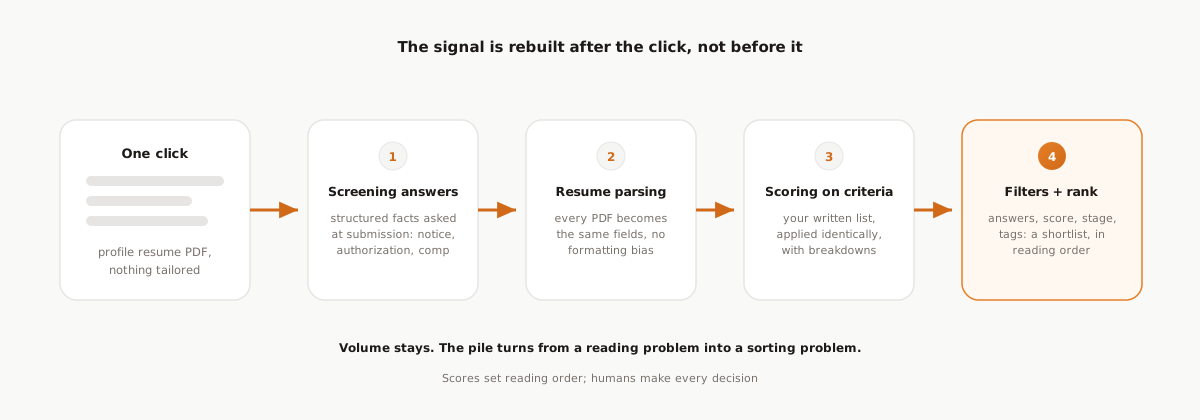
None of this reduces the pile. It converts the pile from a reading problem, which does not scale, into a sorting problem, which does. The full method is in our triage playbook for hundreds of applicants.
When the pile actually lands
Here is what that pipeline looks like in practice, since "recover the signal" is easy to say and tedious to wire up by hand.
The Reordinal Chrome extension exports your LinkedIn Easy Apply applicants in batches, each with their resume PDF and their complete screening answers, into one job in Reordinal. Every resume is parsed on import and scored against the criteria you set for the role, with a per-criterion breakdown showing what matched and what is missing. The list view then does the narrowing: filter by screening answers, score range, stage, or tags, and hand your co-founder a shortlist with verdicts recorded on each candidate instead of a shared inbox and a prayer.
The volume side of the trade stops being a threat at that point. Three times the applicants through the same screening pipeline is three times the chances the right person is in there, which is the outcome you wanted when you enabled Easy Apply in the first place.
Screen with the lights on
One last piece, because rebuilding signal with parsing and scoring means you are now using AI in hiring, and candidates have opinions about that. In Greenhouse's 2025 AI trust survey of 4,136 respondents across the US, UK, Ireland, and Germany, 70 percent of hiring managers said they trust AI to make faster and better hiring decisions. Only 8 percent of job seekers called AI-driven hiring fair.
That gap is not a reason to skip the tooling; it is a reason to be plain about how you use it. Scores set reading order, humans make decisions, and every candidate gets an answer. Say so in the post or in your first reply. We wrote a longer piece on what makes AI resume screening trustworthy, and the short version is that transparency is most of it.
Easy Apply already decided the volume question for you. The signal question is still yours, and it is won after the click: structured questions at publish, parsing instead of skimming, criteria instead of vibes, and filters instead of a cold start on applicant one.
Frequently asked questions
Does LinkedIn Easy Apply get more applicants than an external application?
Yes, by roughly three times. Appcast's 2025 benchmark report measured a 19.37 percent apply rate for one-click flows like Easy Apply in 2024, against a 6.1 percent median for long, ATS-hosted flows. The gap comes from removed friction, not from the job itself.
Are Easy Apply candidates lower quality?
The candidates are not lower quality; each application just carries less signal, because one-click applying costs nothing and nobody tailors it. Appcast's own caution is that employers should verify the easier method still produces quality candidates, which in practice means screening harder after the click.
Should I make my application form longer to filter out low-intent applicants?
Usually not. Appcast's data shows apply flows of 1 to 5 minutes convert far better than 10-plus-minute flows, and long forms lose strong busy candidates along with weak ones. A few short screening questions add structure without collapsing conversion, especially for mobile applicants.
How do I screen hundreds of Easy Apply applicants quickly?
Export them out of LinkedIn with their resumes and screening answers, write your criteria down, and let parsing and scoring do the first pass. Then filter by screening answers and review the top of the ranked list, so human reading time lands where it counts.
Should I tell candidates I use AI to screen resumes?
Yes. Greenhouse's 2025 survey found 70 percent of hiring managers trust AI in hiring decisions while only 8 percent of job seekers consider it fair. Saying that scores only set reading order and a human makes every decision costs one sentence and closes most of that trust gap.